Analyze & calculate37 / 68
Calculus inside expressions
Enter derivatives, integrals and sums directly when you want them to become part of a mathematical definition.
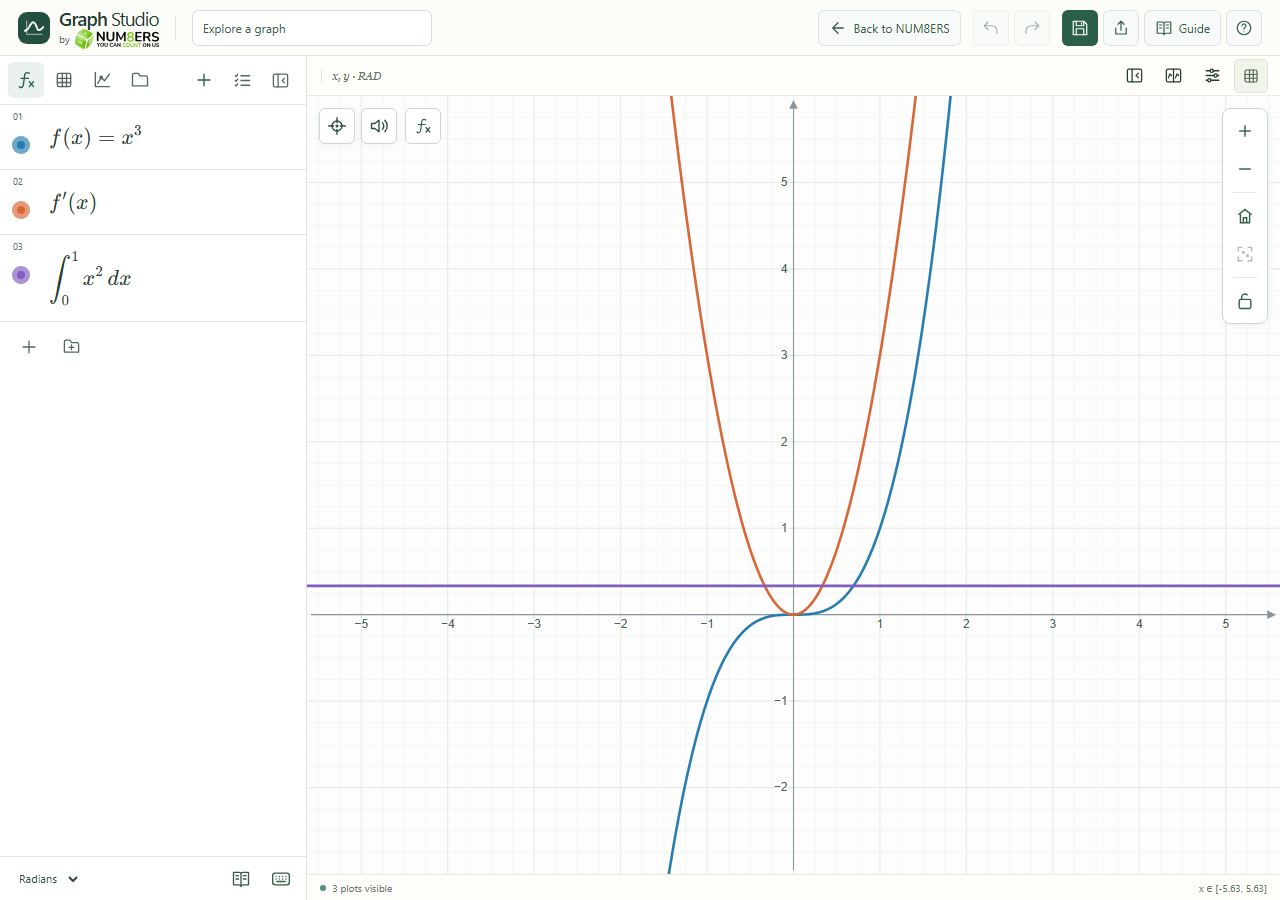 Function, derivative and definite integral in expression rows.Click to enlarge ↗
Try it step by step
- Define a named function when it makes the formula easier to read.
- Enter a derivative or definite integral in another row.
- For parameter-dependent expressions, change the parameter and inspect the result.
- Read convergence and work-limit diagnostics before relying on an advanced result.
Examples to try
Each card is one input. For definitions, enter the cards in order. Formula-only cards belong in the tool described above.
The derivative at 2 is 12.
A definite integral equal to .
A finite sum equal to 15.
Options explained
- Derivatives
- Supported ordinary derivatives reach order 64, subject to the expression and work budget.
- Partial derivatives
- Supported multivariable and mixed derivatives have bounded computational work; complicated nesting may remain unresolved.
- Definite integrals
- Finite integrals and supported convergent improper tails/endpoint singularities can be evaluated inline.
- Moving bounds
- Supported parameter-dependent integrals and derivatives use domain and boundary checks. Nonsmooth or unresolved cases produce gaps or diagnostics.
- Sums / products
- Use finite indexed notation with valid bounds and a supported expression.
- Numerical interpretation
- A reported error estimate is not a mathematical proof. Narrow oscillations and singularities require special care.